


VAN LIFE GUIDE
The Complete Guide to Van Life
From choosing a van to wild camping across Europe. Built on real overlanding experience across three continents - not Instagram fantasy.
In This Guide
3. The build - DIY, professional, or pre-built
4. Essential systems: power, water, heating, cooking
5. Connectivity and working remotely
6. Where to sleep - wild camping and the law in Europe
8. Exterior gear and mounting without drilling
9. What van life actually costs
11. Van life with a partner, kids, or pets
1. What Van Life Actually Is
Van life is living, travelling, or both, out of a converted vehicle. For some people that means a fully built-out Sprinter with underfloor heating and a fixed shower. For others it is a mattress in the back of an old Transporter and a camp stove on the tailgate. Both are valid. There is no minimum specification.
What social media rarely shows is the in-between. The hours spent looking for water. The mornings you wake up in a car park because you arrived too late to find anywhere better. The condensation that drips onto your face at 3 a.m. in November. Van life includes all of that, and it is still worth it - because the good days are extraordinary. Waking up on a Greek beach with no one else around, driving empty mountain passes in Norway, pulling into a vineyard in southern France where the owner waves you in and opens a bottle. Those moments are real and they happen constantly, but only if you are prepared enough that the hard parts do not break you.
Van life comes in different forms. Weekend trips, seasonal travel, year-round full-time living, or multi-year overland expeditions. None is more legitimate than the others. What matters is being honest with yourself about which one you are aiming for, because it changes every decision that follows - the van you buy, how much you spend on the build, the systems you install, and the gear you carry.
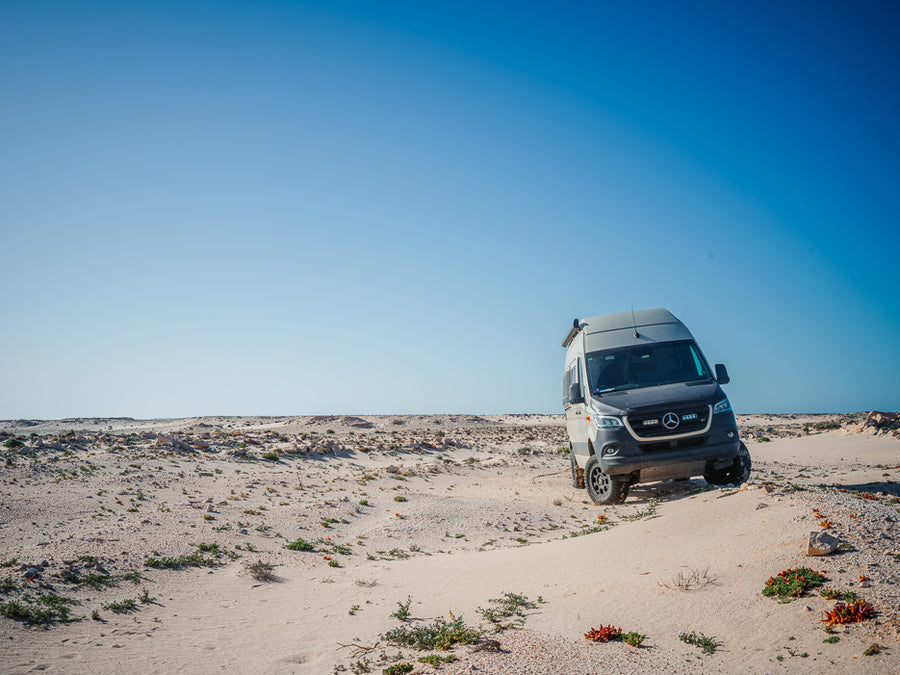
Somewhere between the Atlantic coast and the Sahara. This is not a campsite - just sand, sky, and the right vehicle.
2. Choosing Your Van
This is the decision that determines everything else. In Europe the market is different from North America. You have more options, smaller roads, lower bridges, tighter parking, and stricter emissions zones to think about.
The Main Base Vehicles in Europe
Mercedes Sprinter
The benchmark. Factory 4x4 option. Wide aftermarket ecosystem. Strong resale. Expensive to buy and repair.
Fiat Ducato
Most popular conversion base in Europe. Cheap to maintain. Excellent parts availability. No factory 4x4. Can feel underpowered loaded.
Ford Transit
Strong engines, good driving dynamics. Dense dealer network. Latest generation competes directly with Sprinter. Slightly smaller aftermarket.
VW Crafter / MAN TGE
Same platform. Good build quality. 4MOTION AWD available. Comfortable cab. More expensive than Ducato, smaller aftermarket.
Renault Master
Often overlooked. Solid and affordable. Latest generation significantly improved. Good choice when budget is the priority.
VW Transporter T5/T6/T7
Ideal as daily driver + weekend camper. Easier to park, cheaper on fuel. The trade-off is significantly less interior space.
⚠ Before you buy
Check the Euro emissions standard. Many European cities now restrict Euro 4 and older vehicles. Paris, Brussels, London, Milan, and Amsterdam also restrict some Euro 5 vehicles. A cheap van that cannot enter the cities you want to visit is not cheap. Check urbanaccessregulations.eu before buying.
What Size Should You Go For?
Bigger is not always better, especially in Europe. A long-wheelbase high-roof van gives you a comfortable living space, but it also means you cannot fit into multi-storey car parks, some fuel stations become tricky, coastal roads in Croatia or Italy can be genuinely stressful, and wild camping options shrink because your vehicle is conspicuous.
If you plan to stay mainly on major routes and campsites, go big. If you want to explore freely and park anywhere, consider a shorter wheelbase or even a mid-size van.
My experience driving through narrow mountain passes in the Atlas, threading through village streets in Georgia, and navigating African tracks taught me that compactness is a feature, not a compromise. You can always carry gear on the outside of your van - that is what the roof and walls are for. You cannot shrink a seven-metre van when the road gets narrow.
3. The Build - DIY, Professional, or Pre-Built
There are three paths. Each has trade-offs that are rarely discussed honestly.
DIY Conversion
The cheapest option and the most rewarding if you enjoy building things. A basic but functional conversion can be done for €3,000-8,000 in materials. A high-end DIY build with proper electrics, plumbing, and insulation can reach €15,000-25,000. Expect three to six months of weekends for a first build, longer if you are learning as you go.
⚡ Safety note: Get a professional to check your gas and electrical systems even if you do everything else yourself. Mistakes in these areas can be lethal.
Professional Conversion
Costs range from €20,000 for a basic layout to €80,000+ for a fully custom build. You get warranty, safety compliance, and better resale value. The downside is cost and lead times - popular converters have waiting lists of six months to a year. In Europe, well-regarded converters include Terracamper (Germany), Vanworx (UK), Nomad Vanz (Spain), and dozens of smaller specialists.
Pre-Built Campervans
Factory-converted vans from Westfalia, Pössl, Knaus, Adria, Hymer, and others. Built for volume, so layouts are conservative but functional. Full type approval, warranty, known resale value. Customisation is limited and the lightweight furniture does not always survive rough roads.
⚖ Weight - the thing nobody mentions
Every European van has a maximum gross vehicle weight, typically 3,500 kg. A Ducato L2H2 already weighs around 2,000 kg empty. That leaves 1,500 kg for conversion, water, passengers, and gear - and it fills up faster than you think. Weigh your van after the build and again when loaded. Being over the limit is illegal, dangerous, and voids your insurance in most European countries.
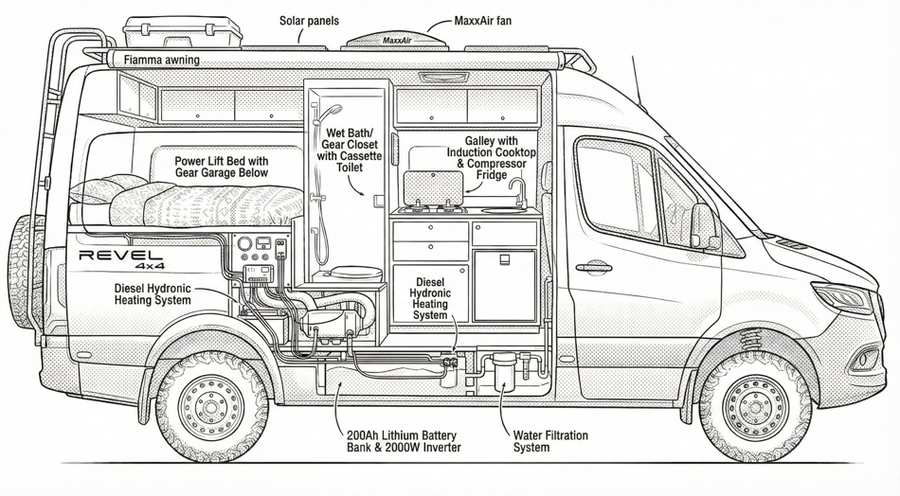
Anatomy of a conversion. Illustration by Tactic Engineering.
4. Essential Systems
The four systems that determine whether your van is liveable or miserable: power, water, heating, and cooking. Get these right and everything else is detail.
☀ Power
The electrical system is the heart of your van. The standard setup: a lithium iron phosphate (LiFePO4) battery bank charged by solar panels, the alternator while driving, and optionally a mains hook-up.
A 200 Ah lithium battery paired with 200-400 W of solar covers most needs: fridge, lighting, phone and laptop charging, diesel heater fan, and water pump. If you work remotely, go bigger - 400 Ah with 400 W solar and a 2,000 W pure sine wave inverter will run almost anything except air conditioning.
Key rule: Size your system for winter, not summer. Solar output drops dramatically in northern Europe from November to February.
💧 Water
A fresh water tank of 80-120 litres is typical for a couple. Solo and conservative, 60 litres is enough for four to five days. A small 12 V pump, a simple filter, a sink, and a grey water tank underneath complete the system.
More important than tank size is knowing where to fill up. In southern Europe, public fountains are common and usually drinkable - look for agua potable in Spain and acqua potabile in Italy. In Scandinavia, streams and lakes are often clean enough to filter. In the Balkans and North Africa, carry extra jerrycans and fill up at every reliable source.
🔥 Heating
If you travel outside summer, heating is not optional. Diesel heaters (Webasto, Eberspächer, or Chinese-made units) tap into your fuel tank, use minimal power, and heat a van effectively.
Webasto and Eberspächer: more reliable, quieter, €1,000-2,000 installed. Chinese diesel heaters: €100-200, surprisingly effective, noisier and less refined.
Non-negotiable: Install a carbon monoxide detector. Whichever heater you choose.
🍳 Cooking
A two-burner gas stove covers 90% of cooking needs. In Europe, propane in refillable bottles is most practical - but gas fittings differ between countries. Carry adapters for at least three systems (French, German/Scandinavian, and Italian/Iberian bayonet).
Alternative: a portable induction hob if your electrical system handles 1,000-1,800 W through an inverter. Many vanlifers carry both - gas for daily cooking, induction for hook-up or strong solar days.
🚽 Toilet
Cassette (Thetford/Dometic), composting (Nature's Head, Trelino), or no fixed toilet. Composting toilets are growing in popularity - no chemicals, no dump stations needed.
🚿 Shower
Built-in showers use space and create moisture. Many experienced vanlifers skip them: solar showers, gym memberships, municipal pools, and beach showers cover most needs. A portable pressurised shower hung from the outside of your van is often the most practical solution.
 Magnetic Outdoor Shower Kit
Shower head mount, towel hook, and accessories - all magnetic. Sticks to any steel panel, moves anywhere, comes off in seconds. No drilling, no suction cups that fall off mid-rinse. View product →
5. Connectivity and Working Remotely
Reliable internet has changed van life from a gap-year novelty into a sustainable lifestyle. The combination of good mobile data coverage across Europe and affordable eSIMs means most van lifers can work remotely without major issues - most of the time.
📱
Mobile Data
Local eSIMs (Holafly, Airalo) or EU roaming plans. EU abolished roaming charges for fair use.
📡
Signal Boosting
External roof antenna + booster bridges the gap between no connection and a stable video call.
🛰
Starlink
Broadband speeds almost anywhere with sky view. Transformed remote van life. Hardware + subscription add up.
Starlink has been the single biggest change to remote van life in recent years. The Starlink Mini is compact enough for van use and provides broadband-level speeds almost anywhere with a view of the sky. The challenge is mounting: it needs a clear view and a secure position that does not involve drilling through your roof.
 Magnetic Starlink Mini Mount
Attaches to any steel vehicle roof with neodymium magnets. No drilling, no adhesive, no permanent modification. Repositions in seconds for optimal signal. View product →
6. Where to Sleep - Wild Camping and the Law in Europe
This is where van life in Europe differs fundamentally from North America. There is no equivalent of BLM land or vast national forests with dispersed camping. Wild camping laws vary dramatically between countries, and getting this wrong can mean fines, vehicle towing, or a knock on the door at midnight.
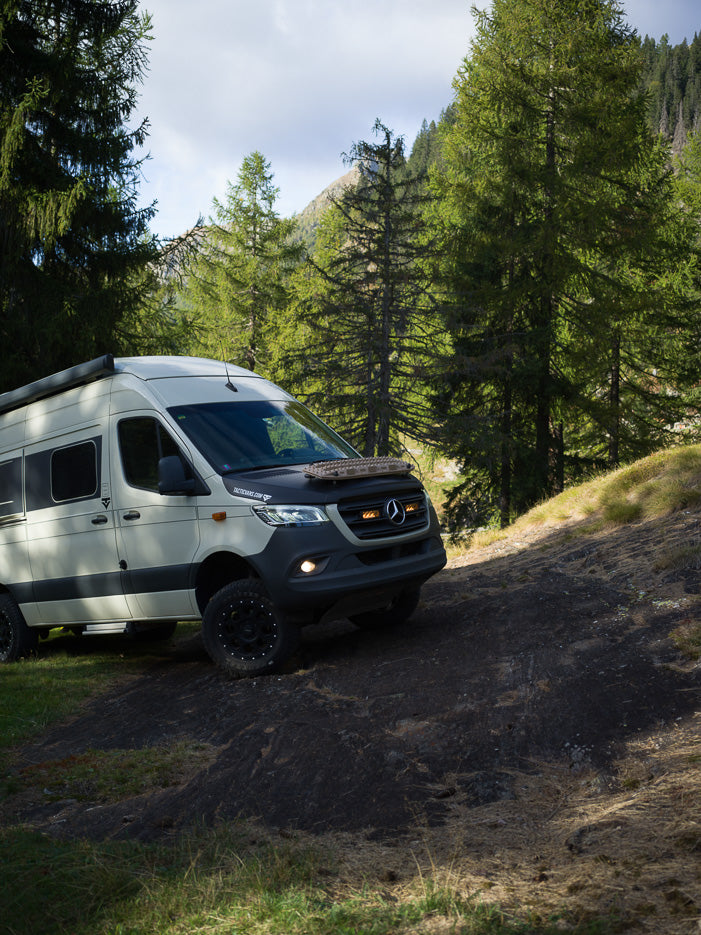
Alpine forest trail in the Swiss-Italian border region. Recovery boards on the roof, all-terrain tyres on the ground. This is what van life actually looks like.
Country-by-Country Overview
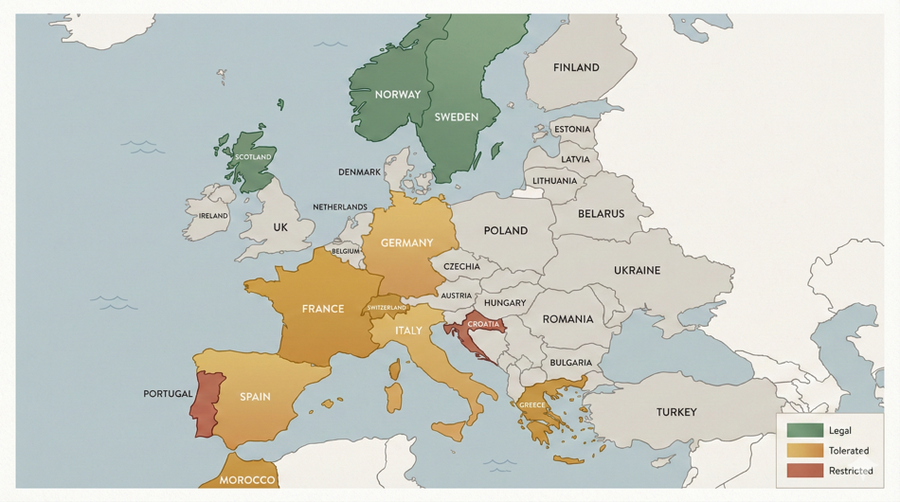
Wild camping status across Europe and Morocco. Graphic by Tactic Engineering.
| Country | Wild camping status | Notes |
|---|---|---|
| 🇳🇴 Norway | Legal (allemannsretten) | 150 m from houses. Increasingly restricted in Lofoten and other popular areas. |
| 🇸🇪 Sweden | Legal (allemansrätten) | One night in the same spot. Respect nature, leave no trace. |
| 🏴 Scotland | Legal (right to roam) | Camping management zones restrict motorhomes in parts of the Highlands. |
| 🇫🇷 France | Overnight parking tolerated | Parking = OK. Deploying awnings, chairs, tables = camping = restricted. Many free aires de stationnement. |
| 🇪🇸 Spain | Grey area | Overnight parking generally tolerated. Camping outside designated sites not permitted. Enforcement varies by region. |
| 🇵🇹 Portugal | Restricted | Illegal in much of the Algarve. Fines up to €600. Municipal áreas de serviço growing. |
| 🇮🇹 Italy | Parking tolerated | Same as France: parking fine, camping equipment not. Many towns have free or cheap aree di sosta. |
| 🇩🇪 Germany | One-night rest stops allowed | Legal to restore driving fitness. No extended stays or camping setup. Affordable Stellplätze everywhere. |
| 🇬🇷 Greece | Technically illegal, widely tolerated | Very relaxed enforcement outside protected areas. Be discreet. |
| 🇭🇷 Croatia | Illegal outside campsites | Fines enforced, especially along the coast in summer. |
| 🇨🇭 Switzerland | Regulated by cantons | Generally tolerated above the treeline and in remote areas. Not near lakeshores or tourist spots. |
| 🇲🇦 Morocco | Generally tolerated | Wild camping common and culturally accepted. Respect private land. Ask locals when in doubt. |
The golden rule across all of Europe
Arrive late, leave early, leave no trace. If you do not deploy awnings, chairs, or tables, you are parking - not camping. This distinction protects you legally in most countries. Be quiet, keep your lights low, take your rubbish, and do not park where signs or barriers tell you not to.
Finding Spots
The apps that European vanlifers rely on most: Park4Night (largest European database of free and paid overnight spots with user reviews), iOverlander (better for routes beyond Europe - Africa, Central Asia, the Americas), and Caramaps (focused on official aires and Stellplätze). Cross-reference between apps. A spot rated five stars in summer may be flooded, closed, or overrun in another season.
Satellite view in Google Maps is your friend. Look for wide pull-offs, dead-end forest roads, agricultural tracks with turning space, and quiet coastal access roads. After a few months, finding spots becomes instinctive.
7. Daily Life on the Road
🍳 Cooking
One-pot meals are your foundation: pasta, rice dishes, stews, soups. A pressure cooker saves gas and time. Stock a core pantry that does not need refrigeration: olive oil, pasta, rice, couscous, tinned beans, tinned tomatoes, garlic, onions, spices. Visit local markets instead of supermarkets - cheaper, fresher, and it connects you with where you are.
💧 Water Management
The fastest way to run out of water is dishes. Use one pot, one plate, one cup, and wash immediately with minimal water. A spray bottle for rinsing uses a fraction of what a running tap does. Carry a collapsible 10-litre jerrycan for top-ups from fountains, streams, or friendly locals.
👕 Laundry
Self-service launderettes exist across Europe: laveries automatiques (France), lavanderie (Italy). Budget €5-8 per load including drying. Between visits, hand-wash essentials in a dry bag with biodegradable soap and hang them to dry inside or from your awning.
📋 Routine
Van life without routine becomes chaotic. Morning coffee and planning, daily water and power check, regular tidying (clutter accumulates within hours), weekly admin for finances and route planning. Freedom and routine are not opposites - routine is what makes freedom sustainable.
8. Exterior Gear and Mounting Without Drilling
Most vans cannot carry everything inside. Recovery boards, awnings, shovels, fuel cans, solar showers, Starlink dishes - the exterior of your van is valuable real estate. The traditional approach is drilling holes, bolting on racks, and living with the rust and resale-value damage that follows.
The alternative is magnetic mounting. If your van has a steel body (most do - run a kitchen magnet along the panels to check), high-grade neodymium magnets with rubberised coatings can hold serious loads without any permanent modification. Move gear between positions, remove everything for cleaning, sell your van later without a single extra hole.


Whether you use magnetic mounts or traditional rack systems, think carefully about what you actually need on the outside versus what looks good. Every external item adds wind resistance, noise, and potential theft risk. Carry what you use regularly. Store the rest inside.
9. What Van Life Actually Costs
The honest answer: it depends entirely on how you travel. But here are realistic European figures that hold true across years of conversations with other vanlifers and my own experience.
One-Off Costs
The Van
€8K - €50K+
Older Ducato from €8K. New Sprinter from €50K.
The Conversion
€3K - €80K+
Basic DIY from €3K. Full professional from €25K.
Monthly Running Costs (Full-Time, Europe)
€800 - €1,200/month — Budget
Wild camping most nights, cooking every meal, careful fuel management, discount supermarkets. Easier in southern and eastern Europe.
€1,500 - €2,500/month — Comfortable
Mix of wild camping and paid sites, occasional eating out, gym membership, some activities. Where most full-time vanlifers settle.
€3,000+/month — Premium
Regular campsites, restaurants, activities, Starlink, higher insurance, newer vehicle with financing.
The biggest variable costs are fuel and campsite fees. Fuel prices across Europe vary by up to 50% between countries - Luxembourg, Spain, and Poland tend to be cheaper while Norway, the Netherlands, and Denmark are among the most expensive. Plan fuel stops accordingly.
📋 Insurance and registration
Your van must be registered and insured in your country of residence. If you have converted it to a campervan (véhicule aménagé in France, Wohnmobil in Germany, autocampere in Italy), register it as such. This can affect insurance rates, tax, toll pricing, and where you are allowed to park.
10. Safety and Security
Van life in Europe is generally very safe, but it is not without risk. The most common issues are petty theft (especially in tourist areas of southern France, Spain, Italy, and Morocco) and break-ins while you are away from the van.
🅿 Park Smart
Well-lit areas near other vehicles are safer than isolated urban-fringe spots. In rural areas, isolation is usually fine. Trust your instincts - if a spot feels wrong, drive on.
🔒 Secure Your Van
Deadlocks on all doors, steering wheel lock visible through windscreen, window covers. A small safe bolted to chassis for passports, cash, electronics. Consider a GPS tracker.
🚐 Driving Safety
Know your van's height (sticker on dashboard), weight, and turning circle. Mountain roads in the Alps, Pyrenees, and Balkans are spectacular but demanding. Take it slow on unfamiliar roads.
🩹 Emergency Kit
First aid kit, fire extinguisher, CO detector, warning triangle, hi-vis vest, tools, jump leads, tow rope, torch. Satellite communicator (Garmin InReach) for areas without mobile signal.
11. Van Life with a Partner, Kids, or Pets
With a Partner
The smallest argument in a house becomes the biggest argument in a van, because there is nowhere to go. Successful couples establish personal space rituals - one person walks while the other has the van, or you agree on quiet hours. Discuss expectations before you leave: who drives, who navigates, who cooks, how decisions are made when one person wants to stay and the other wants to move on.
With Children
Families are the fastest-growing segment of the van life community. Children adapt remarkably well, often faster than their parents. Key considerations: schooling (online learning, world-schooling, or a combination), child-safe layouts (sharp corners, hot stove access, sleeping arrangements), and routine - children need predictability even within an unpredictable lifestyle.
Having a baby in a van is possible - I know this from experience - but it amplifies every logistical challenge. Plan for more stops, more water use, and less spontaneity, especially in the first year.
With Pets
Dogs are natural vanlifers. Main challenges: temperature management (never leave a dog in a closed van - even 20°C outside can become lethal inside), border crossings (EU pet passport, rabies vaccination, additional treatments by country), and access restrictions at beaches, national parks, and towns. Carry enough water and know veterinary options along your route.
12. Common Mistakes and How to Avoid Them
Building too heavy
It is tempting to install everything - oven, fixed shower, huge tanks, hardwood cabinetry. Then you weigh the van and you are 400 kg over the legal limit. Start minimal. Add as you discover what you actually need.
Skipping insulation
A van without proper insulation is a metal box that amplifies every temperature extreme. Unbearable in summer, freezing in winter. Condensation will soak your bedding and grow mould on every surface. Insulate before anything else.
Underestimating power needs in winter
A solar system sized for July in southern Spain will produce a fraction of that in January in the Netherlands. Design for worst case, not best case.
Carrying too much gear
After a few weeks on the road, you will know exactly what you use and what just takes up space. Be ruthless about editing your kit.
Neglecting maintenance
A van that runs every day on varied terrain needs more frequent servicing than a city car. Check oil, coolant, tyre pressures, brake pads regularly. Carry spare belts, fuses, and fluids.
Not having a financial buffer
Breakdowns, fines, medical expenses, sudden ferry bookings. Set aside at least €2,000 beyond your normal budget as contingency.
Ignoring local customs
You are a guest in every country you visit. Learn basic greetings. Ask before parking on someone's land. Leave every spot cleaner than you found it. The future of van life depends on how today's vanlifers behave.
13. Frequently Asked Questions
How much does it cost to start van life?
A functional setup starts from around €12,000-20,000 (older van + basic DIY conversion). Comfortable mid-range: €35,000-60,000. Professional conversions on new Sprinters can exceed €120,000.
Can I live in a van legally in Europe?
Living in a van is not illegal in most European countries. The legal nuances relate to where you park overnight, how long you stay, and whether your vehicle is registered as a campervan. Residency, tax, and registration laws apply regardless.
What is the best van for van life in Europe?
The Fiat Ducato is the most popular for good reason: affordable, widely serviced, well-understood by converters. The Mercedes Sprinter offers more refinement and a factory 4x4. The Ford Transit is a strong all-rounder. The best van is the one that fits your budget, routes, and build requirements.
How do I get mail and packages on the road?
Use a family member's address or a mail forwarding service. In many EU countries you can have packages delivered to post office collection points, Packstationen (Germany), or Amazon Lockers.
Is van life safe for solo travellers?
Yes, with standard precautions. Good locks, smart parking, trusting your instincts, sharing your location with someone, and carrying communication that works without mobile signal in remote areas.
How do I stay fit and healthy?
Outdoor exercise is the most natural fit: hiking, cycling, swimming, running. A gym membership (McFit, Basic-Fit) gives you showers and workouts. Local markets and cooking your own meals makes eating well easier.
How do I handle healthcare and insurance?
EU citizens: your EHIC card gives access to public healthcare across EU/EEA countries, but it does not cover everything. Travel insurance with medical evacuation is strongly recommended. Outside the EU, comprehensive travel insurance is essential.
Can I work remotely from a van?
Yes, and increasingly well. Mobile data across Europe is strong, eSIMs make switching easy, and Starlink has filled the remaining gaps. The practical challenges are reliable power and a comfortable workspace.
Ready to Kit Out Your Van?
Magnetic mounts, awning brackets, Starlink holders, recovery board mounts - designed to install without a single hole in your van.
BROWSE PRODUCTSWritten by Gaetan Della Pietra, founder of Tactic Engineering. Based in Ticino, Switzerland. Still sleeping in vans whenever possible.

